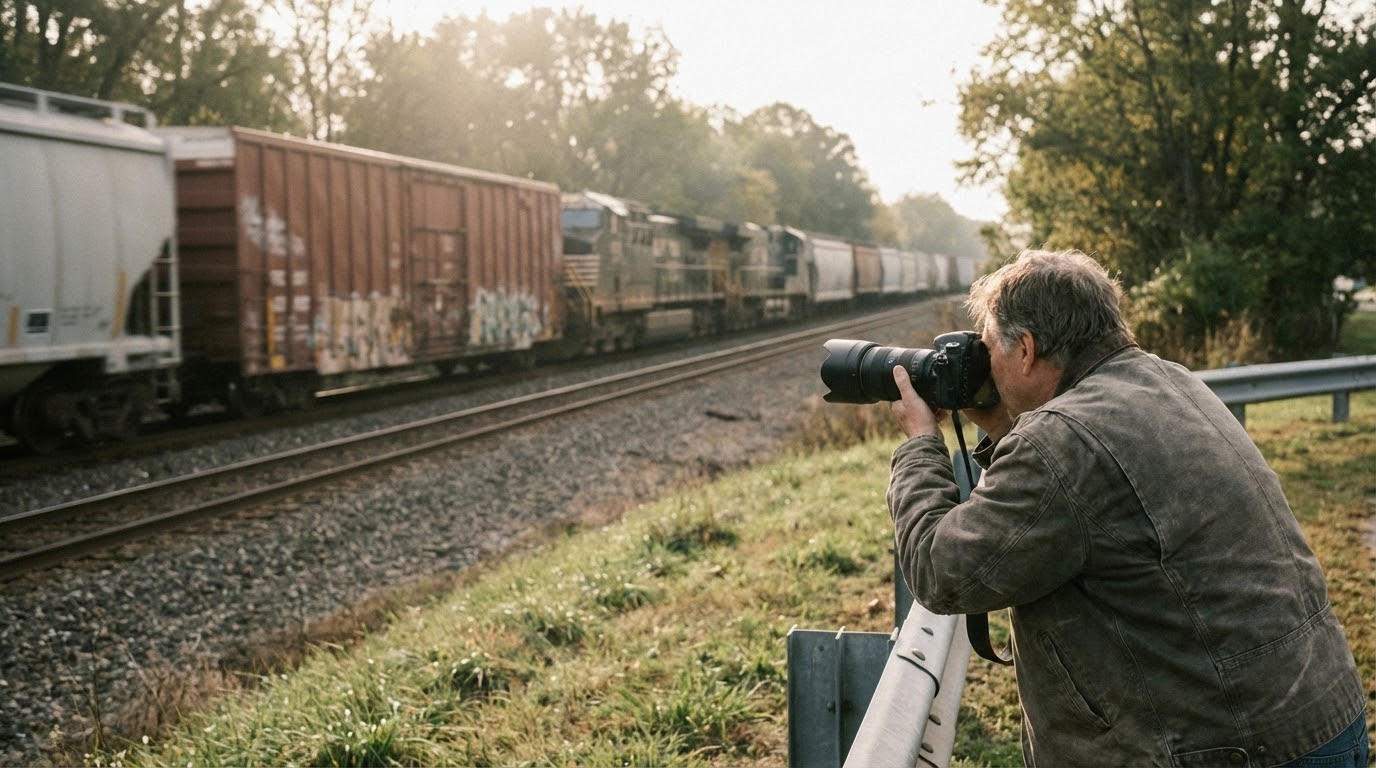
Train Photography Tips
A locomotive thundering through a mountain pass. A switcher shuffling cars in morning fog. A passenger train gliding across an open prairie. These moments define railroad photography—a pursuit combining technical skill, historical appreciation, and the thrill of the chase. Whether you’re shooting with a smartphone or professional mirrorless camera, these tips will help you capture images that honor the power and presence of North American railroading.
Safety First: The Non-Negotiable Rules
Before discussing cameras or composition, we address safety. Railroads are active, dangerous workplaces. Every year, trespassers are killed or injured on railroad property.
The Legal Basics
Railroad right-of-way is private property. Walking on tracks, standing on bridges, and climbing signal towers are trespassing—regardless of how many photographers you’ve seen do it on social media. Railroad police actively patrol, and citations carry significant fines.
Safe Shooting Practices
- Shoot from public property – Roads, bridges over tracks (not railroad bridges), and designated public areas are legal.
- Never assume a track is inactive – Trains run on unexpected schedules. Quiet tracks become active without warning.
- Maintain situational awareness – Look both directions before crossing any track. Trains from either direction can approach silently.
- Keep distance from equipment – Standing cars can move without warning. Locomotives idle then lurch into motion.
- Respect railroad employees – They have jobs to do. Don’t interfere with operations or ignore their directions.
The best photograph isn’t worth your life or a criminal record. Prioritize safety absolutely.
Camera Equipment for Train Photography
Great train photographs have been made with every type of camera. Equipment matters less than understanding how to use what you have.
Camera Bodies
Any camera with manual controls and fast autofocus serves train photography. Modern mirrorless cameras from Sony, Canon, Nikon, and Fuji offer excellent performance. Traditional DSLRs remain capable. Even advanced smartphones produce impressive results in good light.
Key features for train work:
- Fast continuous autofocus – Trains approach quickly; tracking AF helps maintain focus.
- Reasonable high-ISO performance – Dawn and dusk shooting requires acceptable noise at ISO 3200+.
- Fast frame rate – 5-10 frames per second captures optimal moments from passing trains.
- Weather sealing – Railfanning happens in all conditions; sealed bodies survive better.
Lenses
Versatility matters in train photography. You often can’t move to adjust composition—you work with the angle you have.
Telephoto zooms (70-200mm, 100-400mm) – The workhorse lenses for train photography. They compress perspective, pull in distant trains, and fill frames without requiring close approach. A 70-200mm f/2.8 handles most situations; longer reach helps in open country.
Wide-angle lenses (16-35mm, 24-70mm) – Capture trains in landscape context, showing mountains, curves, and scenery. Wide angles require closer positioning but create dramatic environmental images.
Prime lenses – A fast 50mm or 85mm prime works for static equipment, yard scenes, and detail shots where composition is controlled.
Accessories
- Monopod – Steadies long telephoto shots without tripod bulk; quick to deploy for approaching trains.
- Polarizing filter – Reduces glare from locomotive paint and enhances sky contrast.
- Scanner or app – Railroad radio frequencies let you hear dispatcher communications and anticipate train movements.
- Lens hood – Essential for reducing flare when shooting toward light sources.
Camera Settings for Moving Trains
Trains move fast but predictably. Appropriate settings freeze motion while maintaining depth of field and correct exposure.
Shutter Speed
Moving trains demand fast shutter speeds. Start with these minimums:
- Passing trains (parallel to camera) – 1/1000 second or faster
- Approaching trains (head-on) – 1/500 second usually sufficient
- Slow-speed switching – 1/250 second works for yard movements
- Static equipment – 1/125 second or slower, using tripod if needed
Panning—tracking a moving train while shooting—allows slower speeds (1/250 to 1/60 second) while intentionally blurring background for motion effect. This technique requires practice but produces dynamic images.
Aperture
Aperture controls depth of field—how much of the scene appears sharp. For full-train sharpness, use f/8 to f/11. Wider apertures (f/2.8-f/5.6) isolate locomotives from cluttered backgrounds but risk focus errors.
Consider your background. A clean hillside allows wide apertures; a busy industrial scene benefits from greater depth of field that includes context.
ISO
Use the lowest ISO that achieves your shutter speed goal. Bright daylight allows ISO 100-400. Overcast conditions push toward ISO 800-1600. Dawn and dusk may require ISO 3200-6400 or higher. Modern sensors handle high ISO remarkably well—prioritize shutter speed over low noise.
Autofocus Modes
Use continuous autofocus (AF-C or AI Servo) for approaching trains. Single-shot autofocus can’t track a locomotive coming toward you at 60 mph. Set your camera to track the locomotive headlight or nose—these high-contrast elements maintain focus lock.
For static shots, single-shot autofocus with careful focus point selection works fine.
Composition Principles
Strong composition transforms railroad snapshots into memorable images.
The Classic Three-Quarter View
Traditional railroad photography positions the camera at roughly 45 degrees to the track, capturing the locomotive’s nose and one side. This three-quarter view shows locomotive identity and includes the train trailing behind. It’s called the “builder’s view” because manufacturers used this angle for official photographs.
Leading Lines
Railroad tracks are natural leading lines. Use them to draw viewers’ eyes into your image. A track receding toward distant mountains creates depth. Curves sweeping through the frame add dynamic energy.
The Rule of Thirds
Position key elements—locomotive nose, crossing signal, mountain peak—at intersection points of an imaginary 3×3 grid. Avoid centering everything; off-center placement creates visual interest.
Environmental Context
Trains exist in landscapes. Include context that tells a story. A consist curving through autumn aspens says more than a tight crop of just the locomotive. Mountains, rivers, cities, and weather all provide narrative.
Negative Space
Leave room in front of moving trains—space for them to “travel into.” An image cropped tight against a locomotive’s nose feels cramped. The train needs visual breathing room.
Lighting for Railroad Photography
Light makes or breaks photographs. Understanding lighting transforms your images.
Golden Hour Magic
The hours after sunrise and before sunset produce warm, dimensional light. Shadows lengthen, colors saturate, and locomotives glow. Plan your locations to face trains during golden hour when possible.
The Importance of Angle
Sun position relative to train direction matters enormously. Front lighting illuminates locomotive details. Side lighting creates dramatic shadows and dimension. Backlighting silhouettes trains against bright skies—striking but technically challenging.
In North America, eastbound trains receive morning front light; westbound trains favor afternoon sun. Know your train direction and sun position.
Overcast Advantages
Cloudy days diffuse harsh shadows, making paint schemes easier to capture accurately. Overcast light lacks drama but offers consistency. Detail photographers often prefer clouds.
Night Photography
Night railroad photography presents challenges and opportunities. Long exposures capture light streaks from locomotives. Yard lighting creates industrial atmosphere. Flash illuminates static equipment. Night work requires tripods, patience, and experimentation.
Planning Your Shots
Successful railroad photography involves research and planning, not just luck.
Know the Railroad
Study maps showing railroad routes in your area. Understand which carriers operate which lines. Learn typical traffic patterns—some lines run unit trains, others mixed freight, some serve specific industries.
Scout Locations
Visit potential photo spots without your camera first. Check sun angles at different times. Identify safe standing positions. Note potential obstructions. Return when conditions and train timing align.
Use Train Tracking
Various apps and websites track train movements. Understanding dispatcher communications via scanner helps predict arrivals. Local railfan communities share information about notable trains and movements.
Weather Awareness
Weather creates opportunity. Fog, snow, storm clouds, and dramatic skies elevate ordinary train shots. Monitor forecasts and chase interesting conditions. The best railroad photographs often happen in imperfect weather.
For finding great locations to practice these techniques, explore our guide to the Best Railfan Destinations in North America.
Specialized Techniques
Beyond basic photography, specialized techniques expand your creative options.
Panning
Panning involves tracking a moving train while shooting, keeping the locomotive sharp while blurring the background. This creates speed impression and isolates the subject from surroundings. Start with 1/125 to 1/60 second shutter speeds. Track smoothly, follow through after shooting. Success rate is low initially; practice improves results dramatically.
Long Exposure
Multi-second exposures at night or dusk create light trails from locomotives and warning flashers. Use sturdy tripod, remote release, and neutral density filters for twilight timing. Results range from subtle motion blur to dramatic streaks across the frame.
Roster Shots
Roster photography documents specific locomotives with consistent, clear presentation. Position perpendicular to the locomotive side, fill frame with the full unit, maintain level horizon, shoot in even light. Roster collectors value technical consistency over artistic flair.
Detail Photography
Close-up shots of builder’s plates, trucks, weathering patterns, and mechanical details tell stories that wide shots miss. Use shorter focal lengths, careful depth of field, and good light. These images complement action shots in portfolios.
Post-Processing Railroad Images
Digital processing enhances your captures without creating fake images.
Basic Adjustments
Most railroad photographs benefit from standard adjustments: leveling horizons, cropping for composition, adjusting exposure, recovering highlights and shadows. Shoot RAW format for maximum flexibility.
Color Correction
Locomotive paint schemes have specific colors. Union Pacific armor yellow, BNSF orange, CSX blue—accurate representation matters to railfans. Use white balance tools to ensure paint colors render correctly.
Sharpening
Apply appropriate sharpening for your output. Web images need less sharpening than prints. Over-sharpening creates artificial halos and noise amplification.
What Not to Do
Railroad photography generally values authenticity. Adding dramatic skies, removing poles and wires digitally, or compositing trains into scenes they never visited crosses lines for most serious photographers. Document reality; don’t create fiction.
Building Your Railroad Photography Portfolio
Developing your body of work takes time and intentionality.
Edit Ruthlessly
Ten excellent images beat one hundred mediocre ones. Review your shots critically. Keep only your best. Nobody needs to see every frame from a day’s shooting.
Develop a Style
Over time, your preferences emerge. Some photographers specialize in dramatic lighting; others focus on historical documentation. Some chase rare locomotives; others explore mundane beauty in everyday operations. Find what excites you and pursue it deeply.
Share Thoughtfully
Social media and railroad photography forums provide audiences. Share your best work. Accept constructive criticism. Learn from others’ images. The community welcomes new photographers who contribute positively.
Understanding railroad history adds depth to your photography. Context about what you’re shooting—why a locomotive matters, what a location represents—enhances appreciation. Our overview of the Golden Age of American Railroads provides historical background that enriches contemporary railfanning.
Frequently Asked Questions
What’s the best camera for train photography? +
Any camera with fast autofocus, reasonable high-ISO performance, and manual control capability works. Modern mirrorless cameras (Sony A7/A6000 series, Canon EOS R series, Nikon Z series) excel. Traditional DSLRs remain fully capable. Even smartphones produce good results in favorable light. More important than the camera body is understanding your equipment’s capabilities and limitations. Invest in good glass—a quality telephoto zoom matters more than the latest camera body.Is it legal to photograph trains from public property? +
Yes. Photographing trains from public property—roads, sidewalks, bridges crossing railroads (not railroad bridges), public parks—is legal in the United States and Canada. You cannot enter railroad property without permission. Track, bridges, yards, and right-of-way are private property. Some photographers obtain permission for specific access; most work from public vantage points. If railroad employees ask you to leave an area, comply—arguing accomplishes nothing productive.How do I find out when trains will come? +
Multiple resources help predict train movements. Railroad radio scanners let you hear dispatcher communications. Apps like rtlsdr and websites provide real-time tracking. Local railfan groups share information about regular schedules and special movements. Experience at specific locations teaches patterns—many lines have predictable busy periods. However, freight railroading doesn’t follow public schedules; patience remains essential. Sometimes you wait hours; sometimes three trains come in thirty minutes.What lens focal length is best for trains? +
A 70-200mm zoom handles most situations—versatile enough for full-train shots and tight enough for locomotive portraits. In open country, longer reach (100-400mm, 150-600mm) pulls in distant trains. In urban environments, wider lenses capture trains with architectural context. Many serious railfans carry both a telephoto zoom and a wide zoom, switching based on location and creative intent. Start with whatever telephoto you own; upgrade based on actual shooting experience.How do I photograph trains in low light? +
Low light photography requires compromises. Increase ISO to maintain safe shutter speeds—modern cameras handle ISO 3200-6400 acceptably. Use the widest practical aperture. Stabilize with monopod or tripod when possible. For dawn/dusk shots, continuous shooting helps capture optimal moments. Night photography requires tripods and long exposures unless you’re capturing moving trains with intentional blur. Post-processing noise reduction helps high-ISO images. Accept that not every shot works—low light increases failure rate.
The Chase Continues
Train photography combines technical challenge, historical appreciation, and outdoor adventure. Every outing offers potential—the perfect light, an unusual consist, a locomotive you’ve chased for years. The images you capture document living railroad history while expressing your creative vision.
Start with the equipment you have. Learn your camera’s capabilities. Study great railroad photographs and analyze what makes them work. Practice persistently. And above all, stay safe while pursuing this rewarding discipline.
The next train could be the one you’ve waited for. Make sure you’re ready.
Affiliate Disclosure: Off The Rails participates in affiliate programs. Links to products may earn us a commission at no extra cost to you. We only recommend products we genuinely believe benefit the hobby.