DCC vs DC
Every model railroader eventually faces this decision: DC or DCC? The choice affects how you control trains, what equipment you can use, your budget, and ultimately how much you enjoy the hobby. Both systems have devoted advocates, and both remain viable in 2026. This guide explains the differences so you can choose the system that fits your goals.
Understanding the Basics
Before comparing systems, let’s understand what each actually does.
DC (Direct Current) Control
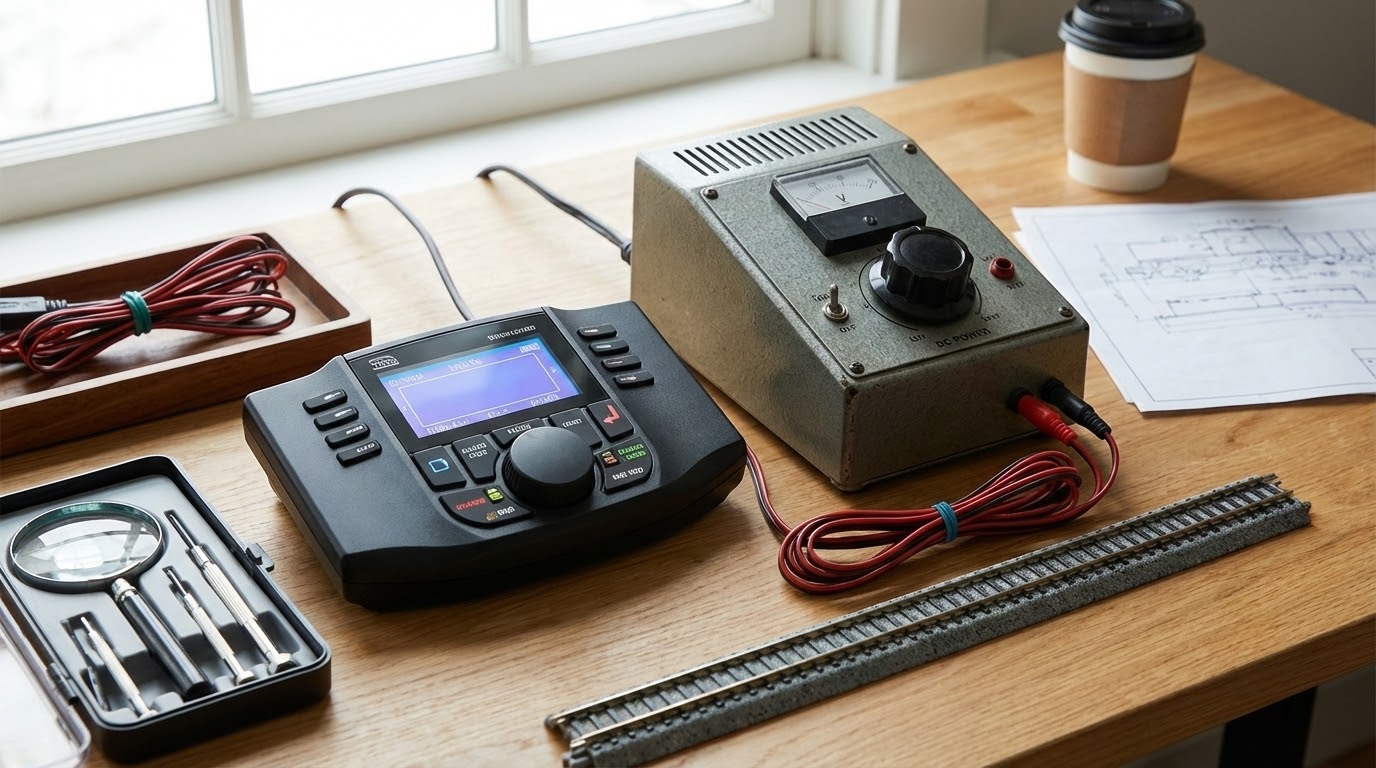
Traditional DC control powered model railroads for nearly a century. A power pack sends variable voltage to the rails. Increase voltage, the train speeds up. Decrease voltage, it slows down. Reverse polarity, and the train reverses direction.
The key point: DC controls trains through the track. Every locomotive on a section of track receives the same voltage. If you want to run multiple trains independently, you need separate electrically-isolated track sections (blocks), each with its own power supply.
DCC (Digital Command Control)
DCC revolutionized model railroading starting in the 1990s. Instead of variable voltage, DCC sends constant power (approximately 14-16 volts AC) plus digital signals to the rails. Each locomotive contains a decoder chip that listens for its unique address. The locomotive responds only to commands directed to its address.
The breakthrough: DCC controls locomotives individually regardless of track position. Two trains on the same section of track can run at different speeds and directions because each responds to its own commands. No block wiring required.
DC Control: The Traditional Approach
DC served model railroaders well for generations and remains viable today.
How DC Works
A DC power pack contains a transformer (converting household AC to appropriate voltages), a rectifier (converting AC to DC), and a throttle (varying output voltage). Turn the throttle, and voltage changes. Simple, intuitive, reliable.
The relationship between throttle position and train speed is direct. New operators understand immediately: more throttle equals faster train. This simplicity has value.
Block Control for Multiple Trains
Running multiple trains with DC requires block wiring. Divide your layout into electrically isolated sections (blocks). Each block connects to a selector switch or separate power pack. Only one locomotive receives power in each block at a time.
Block control works but adds complexity. Wiring multiple blocks means cutting rail gaps, installing insulated joiners, running wires from each block to control panels, and managing switches or multiple power packs. Operating sessions require attention to block assignments—which train is in which block and who controls what.
DC Advantages
- Lower entry cost – A basic DC power pack costs $30-80; quality units around $100-150.
- Simpler initial wiring – For single-train operation, connect two wires and run.
- Any locomotive works – No decoder required; even old equipment operates.
- Immediate understanding – The relationship between throttle and speed is obvious.
- Fewer components to fail – Less electronics means fewer potential failure points.
DC Limitations
- Complex multi-train operation – Block wiring adds significant work and expense.
- Limited functions – Lights typically operate only when moving; no independent control.
- No sound capability – DC can’t support sound decoders effectively.
- Speed control at low voltages – Many locomotives run roughly at very low speeds.
- No consisting – Running multiple locomotives as a single unit requires matching motors.
DCC Control: The Digital Revolution
DCC fundamentally changed what’s possible on model railroads.
How DCC Works
A DCC system consists of three main components: a command station (generating digital signals), a booster (amplifying power), and throttles (sending commands). Many entry-level systems combine command station and booster in one unit.
The command station broadcasts digital data packets over the rails. Each packet contains an address and instructions. Decoders listen continuously. When a decoder recognizes its address, it follows the instructions—speed, direction, lighting, sound triggers, and more.
Locomotive Decoders
DCC-equipped locomotives contain decoder chips installed in place of standard DC circuitry. Decoders range from basic (motor control and lighting) to sophisticated (sound, multiple lighting effects, programmable characteristics). Most modern locomotives are “DCC-ready” with easy decoder installation, or come with decoders factory-installed.
DCC Advantages
- Independent locomotive control – Run any locomotive anywhere without block wiring.
- Sound capability – DCC sound brings locomotives to life with realistic audio.
- Lighting control – Headlights, ditch lights, cab lights, and more—each controllable independently.
- Consisting – Link multiple locomotives electronically to operate as one unit.
- Programming options – Customize speed curves, acceleration, momentum, and behaviors.
- Simpler layout wiring – No blocks needed for basic operation.
- Realistic slow-speed operation – Most decoders improve low-speed motor control.
DCC Limitations
- Higher entry cost – Starter systems begin around $100-150; quality systems $200-400.
- Decoder cost per locomotive – Add $20-50 per locomotive for basic decoders; $100+ for sound.
- Learning curve – Programming addresses and CVs takes some study.
- Troubleshooting complexity – More electronics means more potential failure points.
- Old equipment requires conversion – Non-DCC locomotives need decoder installation.
Cost Comparison: The Real Numbers
Cost often drives the DC vs DCC decision. Let’s examine realistic scenarios.
Scenario 1: Simple Layout, Single Train
DC Cost: Power pack ($75) = $75 total
DCC Cost: Starter system ($150) + decoder ($30) = $180 total
For the simplest case, DC costs less upfront. If you only run one train at a time and don’t need sound or lighting control, DC remains economical.
Scenario 2: Medium Layout, Multiple Trains
DC Cost: Two power packs ($150) + block wiring materials ($75) + selector switches ($50) + 5 locomotives at $0 decoder = $275 total
DCC Cost: Mid-range system ($250) + 5 decoders ($150) = $400 total
DC appears cheaper, but factor in wiring time. Block wiring a medium layout takes 20-40 hours. If your time has value, DCC’s simpler wiring may offset higher equipment costs.
Scenario 3: Larger Layout, Sound Desired
DC Cost: Cannot effectively support sound—not a viable option
DCC Cost: Quality system ($350) + 8 sound decoders ($800) = $1,150 total
If you want sound, DCC is the only practical choice. The cost seems high, but spread over years of hobby enjoyment, sound-equipped locomotives transform the experience.
The Sound Question
DCC sound deserves special attention because it often tips the decision.
What DCC Sound Provides
Sound decoders reproduce locomotive sounds: diesel prime movers, steam exhausts, horns, bells, air compressors, dynamic brakes, and more. Sounds respond to operation—accelerate and the prime mover loads up; brake and air releases hiss.
Quality sound transforms model railroading from visual to multi-sensory experience. Hearing a diesel rev under load or steam chuff up a grade adds dimension that silent operation lacks.
DC and Sound
Technically, some sound systems work with DC, but compromises abound. DC sound boards can’t respond to digital commands, limiting interactivity. Volume and quality suffer. Most serious sound applications require DCC.
If sound matters to you—and once you’ve heard a good sound-equipped locomotive, it probably will—DCC becomes the obvious choice.
Wiring Considerations
Wiring requirements differ substantially between systems.
DC Block Wiring
Multi-train DC operation requires:
- Cutting gaps to isolate blocks
- Installing insulated rail joiners
- Running feeder wires from each block to control panels
- Installing selector switches or routing to multiple power packs
- Careful planning to ensure blocks match operational needs
Block wiring isn’t impossibly complex, but it adds substantial work during layout construction.
DCC Wiring
Basic DCC wiring is simpler:
- Connect two wires from booster to track
- Add feeder wires every few feet for reliable power distribution
- That’s essentially it for basic operation
Advanced DCC installations add power districts (for protection and troubleshooting), detection circuits (for signaling and automation), and computer interfaces. But the baseline is much simpler than DC block wiring.
Converting Between Systems
Starting with one system doesn’t permanently lock you in.
DC to DCC Conversion
Converting a DC layout to DCC requires:
- Replacing power packs with a DCC system
- Installing decoders in locomotives
- Optionally simplifying block wiring (though blocks can remain for power districts)
The locomotive conversions represent the main cost. If you have many DC locomotives, conversion expense adds up. But many modelers successfully convert, spreading decoder purchases over time.
DCC to DC Conversion
Rare but possible. DCC-equipped locomotives often run on DC track, though with limitations (constant lighting, no sound, sometimes jerky operation). Removing decoders returns locomotives to pure DC operation. The DCC system becomes unnecessary.
Making Your Decision
Consider your specific situation.
Choose DC If…
- You’re on a tight budget and want to start running trains immediately
- You’ll primarily run one train at a time
- Sound isn’t important to you
- You already own significant DC equipment and aren’t ready to convert
- You prefer simpler technology with fewer potential failure points
Choose DCC If…
- You want to run multiple trains independently
- Sound appeals to you
- You want individual control of lighting and functions
- You plan to expand your layout and operations over time
- You’re buying new equipment (most is DCC-ready)
- You want simpler layout wiring despite higher equipment cost
The Hybrid Approach
Some modelers start with DC to learn and build affordably, planning to convert to DCC later. This works if you buy DCC-ready locomotives and avoid extensive block wiring. The DC equipment becomes backup or sells to recovering some conversion cost.
For a comprehensive introduction to the hobby including power system considerations, see our Getting Started with Model Railroading guide.
DCC System Recommendations
If you’re leaning toward DCC, here are general recommendations by budget.
Entry Level ($100-200)
Bachmann E-Z Command, NCE PowerCab, and Digitrax Zephyr provide capable starter systems. These handle small to medium layouts with 1-2 operators. Features are limited but sufficient for learning and casual operation.
Mid-Range ($200-400)
NCE Power Pro, Digitrax Zephyr Express with expansion, and ESU ECoS systems offer more addresses, better programming interfaces, and expansion capability. Suitable for medium layouts with growth potential.
Advanced ($400+)
Full NCE systems, Digitrax Chief or Empire Builder, and high-end European systems support large layouts, many operators, and advanced automation. Overkill for beginners but worthwhile for serious operations.
Decoder Recommendations
For non-sound, Digitrax, TCS, and NCE offer reliable options at $20-40. For sound, ESU LokSound, TCS WOWSound, and Soundtraxx lead the market at $100-200 per locomotive. Quality varies—read reviews for specific locomotive applications.
For practical examples of DCC-equipped locomotives, our Kato SD70ACe Review discusses DCC installation and performance in a popular model.
Frequently Asked Questions
Can DCC locomotives run on DC track? +
Many DCC-equipped locomotives have “DC compatibility” and will run on DC-powered track. However, performance varies. Lights often stay on regardless of speed. Sound decoders typically don’t function properly on DC. Some decoders disable DC operation entirely. Running DCC locomotives on DC works for basic testing but doesn’t provide the full DCC experience. Check decoder specifications for DC compatibility before attempting.How difficult is decoder installation? +
For “DCC-ready” locomotives with decoder sockets, installation is plug-and-play—typically 5-10 minutes. Older locomotives without sockets require hardwiring decoders, which involves soldering and identifying motor connections. Difficulty varies by locomotive design. YouTube tutorials exist for most popular models. Many hobby shops offer installation services for those uncomfortable with soldering. Sound decoder installation may require speaker mounting, adding complexity.Is DCC harder to learn than DC? +
Basic DCC operation—selecting an address and controlling speed—is straightforward. Programming CVs (Configuration Variables) to customize decoder behavior has a learning curve. You’ll need to understand concepts like addresses, consist setup, and CV programming. However, most operators master basic operation quickly. Advanced programming can be learned incrementally as needs arise. Most modern DCC systems include helpful interfaces and documentation.Can I start with DC and switch to DCC later? +
Yes. Many modelers start with DC to minimize initial investment, then convert to DCC as budget allows. To prepare for eventual conversion: buy DCC-ready locomotives, avoid complex block wiring you’ll later simplify, and consider your DC power pack as temporary equipment. When converting, your main expense is decoders for existing locomotives. The layout wiring conversion is usually straightforward—often simpler than your original DC wiring.What happens if my DCC system fails? +
DCC systems include protective features—most shut down before damage occurs during short circuits. Command stations rarely fail outright. More commonly, individual components (decoders, boosters, throttles) develop issues. Troubleshooting involves isolating the problem component. Having a basic DC power pack allows testing whether problems are layout-related or DCC-system-related. Most DCC equipment is repairable or covered by warranty. Quality systems prove very reliable over years of use.
The Best System Is the One You’ll Use
Both DC and DCC produce enjoyable model railroading. Forums debate endlessly, but either system supports satisfying operation, impressive layouts, and decades of hobby enjoyment.
If you’re paralyzed by the decision, consider: DCC offers more capability and suits most modelers who plan to expand their layouts and locomotive fleets. DC remains viable for simpler operations, tight budgets, and those who prefer traditional technology.
Whatever you choose, you can always change later. The most important thing is to start building, start running trains, and start enjoying the hobby. The control system is just how you make the trains go—the hobby is about so much more.
Affiliate Disclosure: Off The Rails participates in affiliate programs. Links to products may earn us a commission at no extra cost to you. We only recommend products we genuinely believe benefit the hobby.