Union Pacific Big Boy
No locomotive captures the imagination quite like Union Pacific’s Big Boy. These 4-8-8-4 articulated giants—weighing 1.2 million pounds and stretching 132 feet with tender—remain the largest successful steam locomotives ever built. Their story spans the final peak of steam power, decades of preservation, and a remarkable 21st-century resurrection that lets modern audiences experience what railfans in the 1940s witnessed firsthand.
Why the Big Boy Was Built
The Big Boy emerged from a specific operational challenge. Union Pacific’s mainline through Wyoming and Utah crossed the Wasatch Mountains, where steep grades between Ogden, Utah, and Green River, Wyoming, demanded helper engines to move heavy freight trains.
The Ogden-to-Green River Problem
Helper service was expensive and operationally complex. Adding helper locomotives at Ogden meant crew costs, turnaround time, and locomotive availability constraints. Union Pacific wanted locomotives powerful enough to move 3,600-ton trains over Sherman Hill without helpers—a significant ask given the sustained grades involved.
American Locomotive Company’s Solution
Union Pacific turned to the American Locomotive Company (ALCO) in Schenectady, New York. ALCO proposed an articulated locomotive using the 4-8-8-4 wheel arrangement—two sets of eight driving wheels under a single boiler, with a four-wheel leading truck and four-wheel trailing truck. The design built upon experience with Union Pacific’s earlier Challenger 4-6-6-4 locomotives.
The articulated design allowed an enormous boiler—necessary for the power required—while still negotiating curves that would have derailed a rigid-frame locomotive of similar size. Each set of drivers pivoted independently, guided by the leading truck.
Specifications: The Numbers Behind the Legend
The Big Boy’s statistics stagger even those accustomed to steam-era superlatives.
Physical Dimensions
- Total length (with tender): 132 feet, 10 inches
- Engine weight: 762,000 pounds
- Total weight (engine and tender): 1,208,750 pounds
- Height: 16 feet, 2.5 inches
- Driving wheel diameter: 68 inches
- Cylinders: Four, each 23.75 x 32 inches
Performance Specifications
- Boiler pressure: 300 psi
- Tractive effort: 135,375 pounds (starting)
- Horsepower: Approximately 6,000 at speed
- Tender capacity: 25,000 gallons water, 28 tons coal
What the Numbers Mean
The Big Boy’s 135,375 pounds of starting tractive effort exceeded any locomotive before or since. This pulling power allowed the locomotive to start heavy trains on grades that would stall lesser engines. The massive tender capacity enabled long runs between water and coal stops, improving operational efficiency.
Construction and Roster
ALCO built twenty-five Big Boys in two batches, all during World War II when freight demand peaked.
First Order: 1941
Numbers 4000-4019 arrived between September 1941 and January 1942. These twenty locomotives handled the wartime surge in freight traffic as military and industrial shipments flooded the transcontinental line.
Second Order: 1944
Numbers 4020-4024 arrived in late 1944, bringing the roster to twenty-five. By this point, diesel locomotives were entering service, but steam still handled heavy freight on mountain grades where diesel technology hadn’t yet proven itself.
The “Big Boy” Name
Legend holds that an ALCO worker chalked “Big Boy” on a locomotive frame during construction, and the name stuck. Union Pacific never officially designated these locomotives “Big Boy”—internally they were Class 4000—but the nickname became universally recognized.
Big Boys in Service
The Big Boys served Union Pacific for approximately two decades, primarily on the route they were designed for.
The Wasatch Mountains Assignment
Big Boys worked the heavy grades between Ogden and Green River, moving freight that previously required helper engines. The locomotives delivered on their design promise—single-unit capability over territory that had demanded multiple engines.
Typical consists included 3,600-ton trains of 70+ cars. On favorable conditions, Big Boys moved even heavier trains. They operated in both directions, westbound loaded trains climbing to Sherman Summit and eastbound empties returning.
Operational Characteristics
Despite their size, Big Boys were relatively fast for articulated locomotives. Design speeds reached 80 mph, though freight service rarely demanded such velocity. More practically, the locomotives maintained respectable speeds on grades where smaller engines would have labored.
The articulated design proved reliable in service. The ability to negotiate curves that would have defeated rigid-frame alternatives made Big Boys practical despite their dimensions. Maintenance, while substantial, fell within normal steam locomotive parameters.
Fuel and Water Consumption
Big Boys were thirsty. Coal consumption reached 22 tons on a typical run. Water consumption approached the tender’s entire 25,000-gallon capacity. Union Pacific maintained water facilities and coal docks at intervals suitable for Big Boy operations.
The End of Big Boy Service
Diesel locomotives eventually proved more economical than even the mighty Big Boys.
Dieselization Arrives
Throughout the 1950s, diesel-electric locomotives replaced steam across North American railroads. Diesels offered lower operating costs, greater availability (no water stops, no ash removal), and the ability to operate multiple units from a single crew position.
Union Pacific dieselized progressively. By 1959, the Big Boys had made their final revenue runs. The last Big Boy service occurred on July 21, 1959, when No. 4015 pulled an excursion for railroad enthusiasts.
Less Than Twenty Years
The Big Boys served barely eighteen years—an remarkably short career for such significant locomotives. They arrived at steam’s technological peak and departed when diesel economics became undeniable. Their operational window coincided almost exactly with World War II and its immediate aftermath.
Preservation: Eight Survivors
Of twenty-five Big Boys built, eight survive today. All were saved from the scrapper’s torch through preservation efforts in the 1960s.
Museum Locations
- 4004: Cheyenne, Wyoming (Holiday Park)
- 4005: Denver, Colorado (Forney Museum of Transportation)
- 4006: St. Louis, Missouri (National Museum of Transportation)
- 4012: Scranton, Pennsylvania (Steamtown National Historic Site)
- 4014: Union Pacific (operational)
- 4017: Green Bay, Wisconsin (National Railroad Museum)
- 4018: Omaha, Nebraska (Kenefick Park)
- 4023: Omaha, Nebraska (Kenefick Park)
Visiting Static Displays
The preserved Big Boys offer opportunities to experience these locomotives’ scale in person. Standing beside a Big Boy—looking up at the cab, walking the length of the boiler, contemplating the massive drivers—conveys their presence better than any photograph.
For planning visits to see Big Boys and other preserved equipment, our guide to Best Railfan Destinations in North America includes museum and display locations.
Big Boy 4014: The Resurrection
The most remarkable chapter in Big Boy history began in 2013 when Union Pacific acquired No. 4014 with plans to restore it to operation.
Acquisition from RailGiants
Big Boy 4014 had rested at the RailGiants Train Museum in Pomona, California, since 1962. Union Pacific negotiated its acquisition, moving the locomotive to Cheyenne, Wyoming, for restoration at the railroad’s Steam Shop.
The Restoration Process
Restoring a Big Boy to operation required years of work. The Steam Shop team addressed decades of static display wear, rebuilt mechanical systems, converted the locomotive from coal to oil firing (to meet modern emissions requirements), and conducted extensive testing.
The project represented Union Pacific’s commitment to heritage operations, which also maintains Challenger 4-6-6-4 No. 3985 and maintained Northern 4-8-4 No. 844 throughout the diesel era—the only steam locomotive never retired by a Class I railroad.
Return to Steam: May 2019
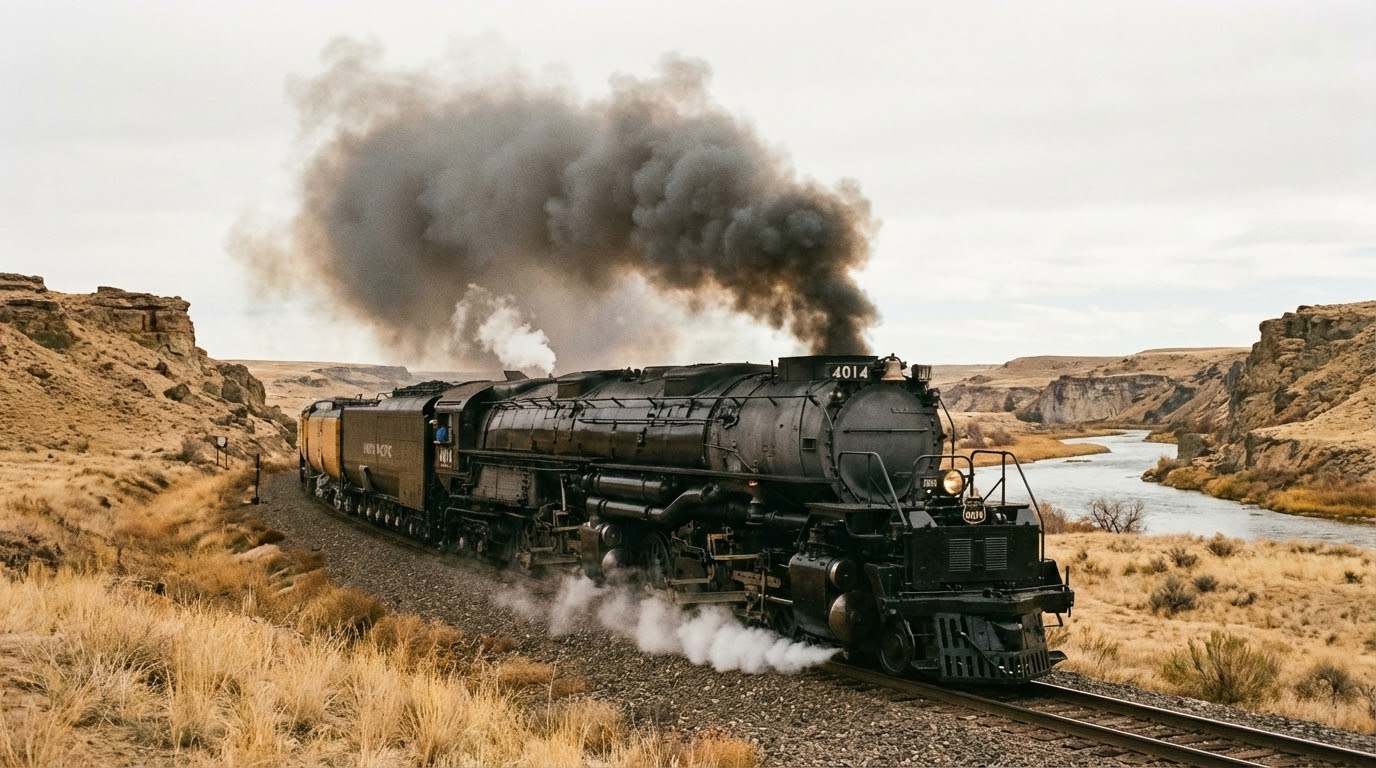
On May 4, 2019, Big Boy 4014 moved under its own power for the first time since 1959. The locomotive joined ceremonies celebrating the 150th anniversary of the transcontinental railroad’s completion, traveling across much of the Union Pacific system.
Seeing 4014 in operation—hearing the rhythmic exhaust beat, feeling the ground shake, watching the drivers turn—offers an experience impossible to replicate with preserved static equipment. Union Pacific schedules periodic excursions and display appearances; check their website for upcoming opportunities.
Big Boys in the Context of Steam History
The Big Boy represents the pinnacle of steam locomotive development—the largest expression of a technology reaching its limits.
End of an Era
Big Boys arrived just as diesel technology began its ascent. They demonstrated what steam could achieve but couldn’t prevent diesel’s advantages from proving decisive. In this sense, they’re bittersweet—magnificent machines born just before their entire technology became obsolete.
Their story fits within the broader Golden Age of American Railroads, representing steam’s final, most ambitious expression before the diesel transition transformed North American railroading.
Engineering Achievement
Beyond sentiment, the Big Boys represented genuine engineering achievement. Moving 1.2 million pounds on rails, generating over 6,000 horsepower from fire, water, and steel, negotiating mountain grades with articulated precision—these accomplishments required solving complex problems with 1940s technology.
Cultural Icon
The Big Boy transcends railroad history to occupy space in broader American culture. The name evokes American industrial might, mid-century confidence, and the romance of western expansion. Model railroaders across all scales reproduce Big Boys. Museums prioritize Big Boy preservation. Union Pacific recognized this cultural significance by investing in 4014’s restoration.
Big Boys in Model Railroading
Given their iconic status, Big Boys appear in virtually every model railroad scale.
HO Scale Options
Athearn, Rivarossi, and Broadway Limited have produced HO scale Big Boys. Quality varies significantly by era and price point. Modern offerings include DCC sound capability. The massive locomotives demand generous curves—24-inch minimum radius, 30-inch or larger preferred.
N Scale Options
Key and others have produced N scale Big Boys, though availability is limited. The locomotives remain impressive even at 1:160 scale and can operate on more typical N scale curves than their HO counterparts.
Operational Considerations
Modeling Big Boy operations requires space. The locomotives look best on sweeping curves with mountain scenery. Point-to-point layouts mimicking the Wasatch Mountains assignment suit Big Boy operations better than small continuous loops.
Frequently Asked Questions
How many Big Boys were built? +
American Locomotive Company built exactly twenty-five Big Boys for Union Pacific. Numbers 4000-4019 arrived in 1941-1942; numbers 4020-4024 arrived in 1944. All twenty-five served until dieselization in the late 1950s. Eight survive today in museums and preservation—a relatively high survival rate for steam locomotives of this era, reflecting their historical significance and the preservation efforts they inspired.Is Big Boy 4014 still operating? +
Yes. Union Pacific restored Big Boy 4014 to operational status in 2019, and it continues to make periodic excursion trips and public appearances. The locomotive operates seasonally, with trips announced on Union Pacific’s Steam website. When not traveling, 4014 resides at Union Pacific’s Steam Shop in Cheyenne, Wyoming. Check Union Pacific’s official announcements for scheduled appearances—events draw enormous crowds.Were Big Boys the most powerful steam locomotives? +
Big Boys produced the highest starting tractive effort of any steam locomotive—135,375 pounds. However, “most powerful” depends on how you measure. Norfolk & Western’s Y-class compounds achieved competitive horsepower at speed. Some experimental locomotives generated higher figures on test. What distinguishes the Big Boy is sustained, reliable power in revenue service on demanding mountain grades—practical power rather than theoretical maximums.Why were only 25 Big Boys built? +
Twenty-five locomotives sufficed for Union Pacific’s specific operational need—the Wasatch Mountain grades between Ogden and Green River. Unlike general-service locomotives usable across a railroad, Big Boys were specialized heavy-haul power for specific territory. Twenty-five units, properly maintained and scheduled, handled the traffic requiring Big Boy capability. More would have been redundant, especially as diesel locomotives began proving themselves.Where can I see a Big Boy in person? +
Eight Big Boys survive. Static displays exist at the National Railroad Museum (Green Bay, WI), Steamtown National Historic Site (Scranton, PA), National Museum of Transportation (St. Louis, MO), Forney Museum (Denver, CO), and other locations. Two reside at Kenefick Park in Omaha. Big Boy 4014 operates on Union Pacific’s system—check their schedule for excursions and static displays. Standing beside any Big Boy conveys their scale in ways photographs cannot.
The Legacy Continues
The Union Pacific Big Boy represents what humanity could achieve with fire, water, and steel—maximum expression of a technology before its successor arrived. Twenty-five locomotives, built over three years, served less than two decades, yet they occupy permanent space in railroad history and American consciousness.
Today, Big Boy 4014 lets new generations experience what 1940s observers witnessed. Standing trackside as 4014 approaches—smoke rising, exhaust pounding, drivers turning—collapses eighty years. The Big Boy that drew crowds in 1942 draws crowds in 2024, still the largest, still magnificent, still worth traveling to see.
That’s legacy. That’s the Big Boy.
Affiliate Disclosure: Off The Rails participates in affiliate programs. Links to products may earn us a commission at no extra cost to you. We only recommend products we genuinely believe benefit the hobby.