Golden Age American Railroads
Between the driving of the Golden Spike in 1869 and the rise of interstate highways in the 1950s, American railroads ruled transportation. They moved millions of passengers, knit together a continent, built cities from nothing, and generated fortunes that shaped American capitalism. This was the Golden Age of American Railroads—a period when trains weren’t just transportation but symbols of national progress.
Defining the Golden Age
Railroad historians generally mark the Golden Age from roughly 1880 to 1950, though some extend it earlier to the transcontinental completion and others argue it ended with World War I. What defines this era isn’t a precise date but a cultural and economic centrality that railroads no longer hold.
During these decades, railroads dominated American life. They were the largest employers outside of agriculture. Railroad stocks drove Wall Street. Railroad time became standard time. Railroad stations anchored downtown districts. The railroad schedule governed commerce, travel, and daily life in ways unimaginable to modern Americans accustomed to highways and airports.
The Transcontinental Achievement
The Golden Age built upon the transcontinental railroad’s completion on May 10, 1869, at Promontory Summit, Utah. When Central Pacific’s Jupiter met Union Pacific’s No. 119, they did more than connect iron rails—they unified a nation still healing from Civil War.
Before the transcontinental railroad, traveling from New York to San Francisco meant either a dangerous overland journey lasting months or a sea voyage around Cape Horn. The railroad reduced this to days. Suddenly, California’s gold, Nevada’s silver, the Great Plains’ wheat, and Texas cattle could reach Eastern markets efficiently. The American West transformed from frontier to economic engine.
The Great Railroad Barons
Transcontinental construction created America’s first industrial tycoons. Cornelius Vanderbilt built his New York Central empire. Jay Gould manipulated railroads and markets with ruthless efficiency. James J. Hill constructed his Great Northern Railway without government land grants, earning the nickname “Empire Builder.” E.H. Harriman consolidated western lines into Union Pacific and Southern Pacific empires.
These men wielded power rivaling governments. They influenced elections, controlled state legislatures, and made or broke entire towns by deciding where to lay track. Their palatial private cars and New York mansions symbolized Gilded Age excess while their workers often labored in dangerous conditions for minimal pay.
The Steam Locomotive’s Evolution
Throughout the Golden Age, steam locomotives grew larger, faster, and more powerful. The evolution from 1880s wood-burning 4-4-0 “American” types to 1940s articulated giants represented remarkable engineering progress.
The Age of the American Standard
The 4-4-0 wheel arrangement dominated 19th-century American railroading. These locomotives—with their balloon smokestacks, cowcatchers, and ornate decoration—define our romantic image of early railroads. They pulled transcontinental trains, mail runs, and local passengers across a growing network.
Bigger, Faster, Stronger
As trains grew longer and heavier, locomotive designers responded with larger boilers, more driving wheels, and innovative technologies. The 4-6-2 Pacific type emerged for passenger service. The 2-8-2 Mikado handled freight. Articulated locomotives like the 2-8-8-2 doubled the power for mountain grades.
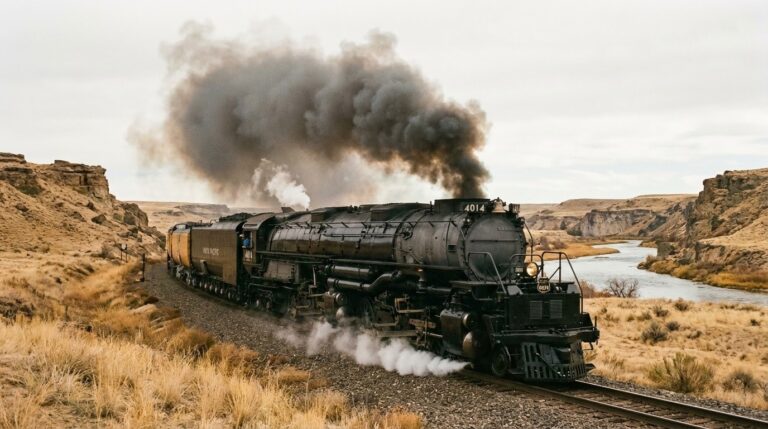
No locomotive better symbolizes this engineering ambition than Union Pacific’s Big Boy. Built during World War II, these 4-8-8-4 articulated giants weighed 1.2 million pounds and could move 7,000 tons over the Wasatch Mountains. They remain the largest successful steam locomotives ever built. For more on these mechanical marvels, read our detailed Union Pacific Big Boy history.
Legendary Named Trains of the Golden Age
The Golden Age gave birth to named passenger trains that became cultural institutions. These weren’t merely transportation—they were experiences, complete with distinctive equipment, attentive service, and romantic destinations.
The 20th Century Limited
New York Central’s premier train connected New York City and Chicago in sixteen hours, competing fiercely with Pennsylvania Railroad’s Broadway Limited. The 20th Century Limited featured all-Pullman accommodations, dining cars rivaling fine restaurants, and a red carpet literally rolled out for boarding passengers at Grand Central Terminal. Industrial designer Henry Dreyfuss restyled the train in 1938 with streamlined J-3a Hudson locomotives and matching coaches, creating an Art Deco masterpiece.
The Super Chief
Santa Fe Railway’s Super Chief linked Chicago and Los Angeles through the Southwest. Its stainless steel consist, designed by Budd Company, hauled Hollywood celebrities and business moguls across the desert. Native American-themed interiors and Fred Harvey dining service created an experience explicitly marketed to the glamorous and wealthy. The Super Chief ran from 1936 until Amtrak absorbed it in 1971.
The California Zephyr
Burlington Route, Denver & Rio Grande Western, and Western Pacific jointly operated the California Zephyr from 1949, showcasing American scenery through Vista-Dome cars. The route through Colorado’s Rocky Mountains and California’s Feather River Canyon remains among the most scenic rail journeys in North America.
The Empire Builder
Great Northern’s Empire Builder honored founder James J. Hill while connecting Chicago to Seattle and Portland through Montana’s glaciated wilderness. The route skirted Glacier National Park, which Great Northern had actively promoted to generate passenger traffic.
Passenger Service at Its Peak
Railroad passenger service reached its zenith during the 1920s and again briefly after World War II. In 1920, over 1.2 billion passenger trips occurred on American railroads—more than any time before or since.
The Pullman Experience
The Pullman Company’s sleeping cars made overnight travel civilized. Named after founder George Pullman, these cars featured convertible berths, private roomettes, and full bedrooms. Pullman porters—predominantly African American men who became legendary for their service—maintained cars and attended to passengers around the clock.
A cross-country journey in Pullman accommodations resembled a moving hotel. Passengers dined in elegant dining cars staffed by uniformed waiters. They wrote letters in observation lounges, watched the landscape flow past, and arrived rested rather than exhausted.
The Streamlined Era
The 1930s Depression-era brought streamlined design to American railroads. Desperate to attract passengers away from growing automobile competition, railroads invested in futuristic trains. Union Pacific’s M-10000 and Burlington’s Pioneer Zephyr—both diesel-powered—captured public imagination with their aerodynamic shapes and high speeds.
Railroads commissioned industrial designers like Raymond Loewy, Henry Dreyfuss, and Otto Kuhler to restyle locomotives and cars. The result was visual coherence—entire trains designed as unified statements from locomotive to observation car. This design philosophy transformed railroad aesthetics permanently.
Freight: The Railroad’s Foundation
While passenger trains captured public imagination, freight traffic generated railroad profits. Moving goods—coal, grain, livestock, manufactured products—built railroad fortunes and sustained operations.
The Intermodal Revolution’s Predecessors
Before modern containerization, railroads developed specialized freight equipment. Refrigerator cars (reefers) allowed California produce and midwestern meatpacking to reach eastern tables. Tank cars moved petroleum from newly discovered oil fields. Boxcars in various configurations handled everything from automobiles to furniture.
Railroad Towns and Industries
Railroads created towns. When track reached a location, businesses followed. Omaha, Denver, Kansas City, Atlanta—all became major cities because railroads chose them as division points or junctions. Conversely, towns bypassed by railroads withered.
Industries clustered along rail lines. Steel mills, grain elevators, packing plants, and factories needed rail access. The industrial landscape of America’s heartland remains shaped by railroad-era decisions about where to lay track.
Railroad Architecture and Stations
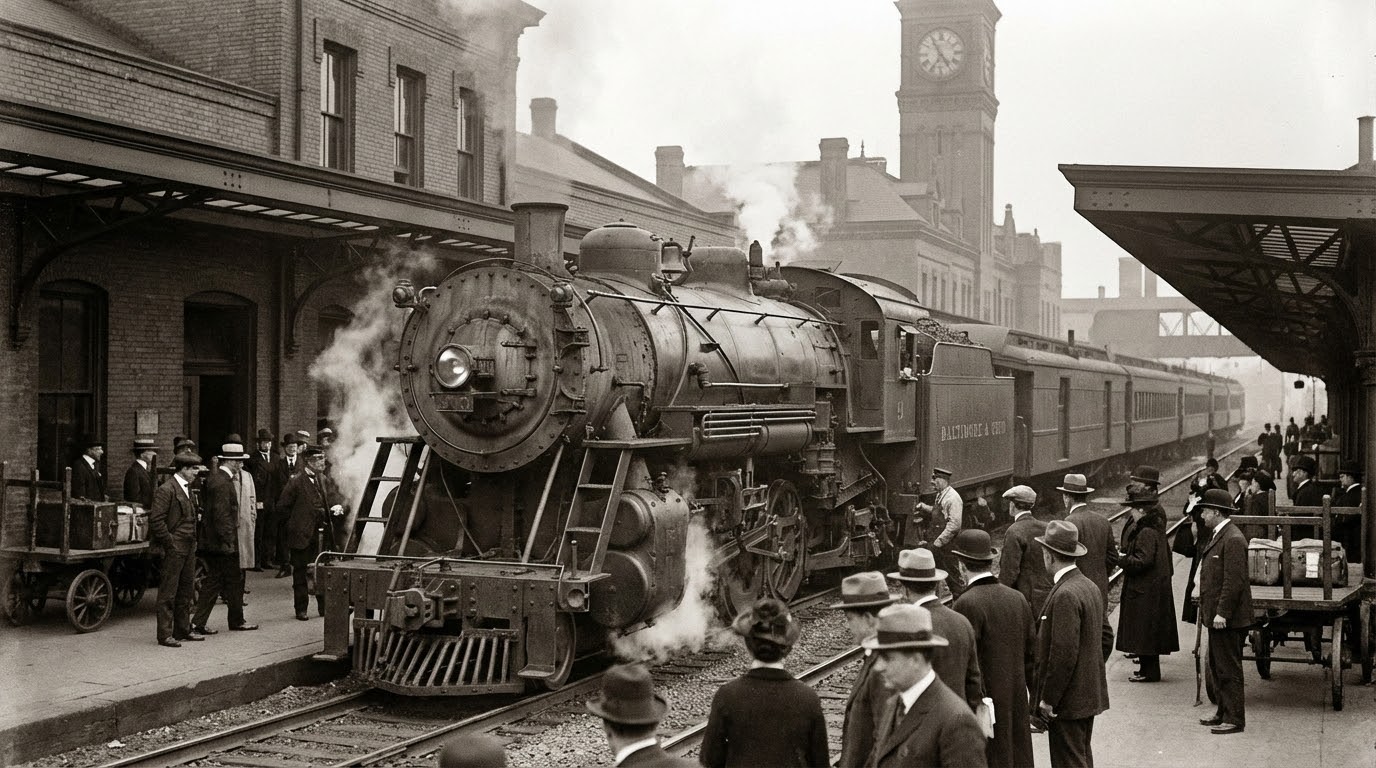
Railroads built cathedrals of transportation. Grand stations announced a city’s importance and a railroad’s prosperity. The architecture ranged from humble wooden depots in prairie towns to monumental urban terminals.
Union Stations
Many cities built union stations serving multiple railroads. Washington’s Union Station, designed by Daniel Burnham and completed in 1907, combined Beaux-Arts grandeur with practical efficiency. Kansas City Union Station’s massive waiting hall could accommodate entire trainloads of passengers. St. Louis Union Station, once the world’s largest, featured a spectacular train shed covering 32 tracks.
Grand Central and Penn Station
New York City’s railroad terminals became architectural icons. Grand Central Terminal, completed in 1913, featured its famous celestial ceiling, massive windows, and ingenious multi-level track arrangement. Pennsylvania Station, designed by McKim, Mead & White, rivaled Roman baths in its grandeur—its 1963 demolition sparked the historic preservation movement.
The Human Cost
Golden Age romanticism obscures difficult realities. Railroad construction and operation killed and maimed workers in staggering numbers. Coupling cars, maintaining track, and operating trains in an era before safety regulations cost thousands of lives annually.
Chinese laborers built Central Pacific’s line over the Sierra Nevada under brutal conditions, drilling tunnels by hand and handling unstable explosives. Irish immigrants and emancipated African Americans performed similar dangerous work for Union Pacific. Their contributions went largely unacknowledged during their lifetimes.
Railroad workers eventually organized. The Brotherhood of Locomotive Engineers formed in 1863. Other crafts followed, creating a union structure that shaped American labor relations for over a century. The Pullman Strike of 1894 became a landmark labor confrontation that reached the Supreme Court.
The Decline Begins
Even at its peak, the Golden Age contained seeds of decline. Automobiles appeared as curiosities in the 1900s and became mainstream by the 1920s. Paved roads improved steadily. The aviation industry grew from nothing to competing with railroads for long-distance passengers.
The Highway Threat
Federal investment in highways accelerated after World War II. The Interstate Highway System, authorized in 1956, provided competition that railroads—burdened by property taxes, regulation, and aging infrastructure—couldn’t match. Trucking captured freight that once moved by rail. Families drove rather than taking trains.
Regulation and Rigidity
Railroads operated under Interstate Commerce Commission regulation that limited flexibility in pricing and service. Labor agreements preserved crew sizes and work rules designed for steam-era operations even as diesel locomotives reduced crew requirements. These constraints handicapped railroads competing against lightly regulated trucking and airlines.
Dieselization
Ironically, the transition from steam to diesel—essential for railroad survival—also ended the Golden Age’s romance. Diesel locomotives proved more efficient, available, and economical than steam. But they also looked alike, lacking the individuality and mechanical drama of steam power. The last major steam operations ended by 1960, and with them went the visual spectacle that had defined railroading.
The Legacy Lives On
The Golden Age ended, but its legacy persists. Railroads still move more freight than any other mode in North America. Amtrak operates named trains—including a revived California Zephyr—over routes established a century ago. Commuter railroads carry millions in major metropolitan areas.
Historic preservation efforts have saved stations, locomotives, and equipment. Excursion railroads offer steam-powered rides. Railroad museums across the continent preserve Golden Age artifacts. And model railroaders recreate the era in miniature, keeping alive memories of named trains, steam giants, and small-town depots.
The places where this history unfolded remain visitable today. Our guide to Best Railfan Destinations in North America highlights locations where Golden Age history comes alive.
Frequently Asked Questions
When exactly was the Golden Age of American Railroads? +
Most historians date the Golden Age from approximately 1880 to 1950, though boundaries vary. The period began after transcontinental completion and initial network expansion, reaching full flower in the early 20th century. Some mark its end with World War I, others with World War II, and some extend it until the final steam locomotives retired around 1960. The common thread is railroad dominance of American transportation—by the 1950s, automobiles, trucks, and airlines had clearly broken that dominance.What was the most famous train of the Golden Age? +
The 20th Century Limited arguably held the highest prestige. New York Central’s flagship train connected New York and Chicago with all-Pullman service, fine dining, and celebrities among its passengers. The Super Chief rivaled it for Hollywood glamour on the Chicago-Los Angeles route. The California Zephyr became legendary for scenic views through its Vista-Dome cars. Regional trains like the Orange Blossom Special and City of New Orleans achieved their own fame.What caused the end of the Golden Age? +
Multiple factors combined. Automobile ownership expanded dramatically after World War II. The Interstate Highway System (begun 1956) provided free, modern roads for cars and trucks. Airlines captured long-distance passengers. Meanwhile, railroads faced heavy regulation, aging infrastructure, and labor agreements that limited adaptation. Passenger service became unprofitable, leading to service cuts that drove more passengers away in a downward spiral.What was the largest steam locomotive ever built? +
Union Pacific’s Big Boy 4-8-8-4 locomotives remain the largest successful steam locomotives ever built. At 132 feet long with tender and weighing 1.2 million pounds, these articulated giants moved heavy freight over the Wasatch Mountains during World War II. Twenty-five were built between 1941 and 1944. Eight survive in museums, and Union Pacific restored No. 4014 to operation in 2019, allowing modern audiences to experience a Golden Age giant.Can I still experience Golden Age railroading today? +
Yes, in several ways. Heritage railroads operate steam-powered excursions across North America. Railroad museums preserve locomotives, cars, and stations. Amtrak’s long-distance trains follow historic routes with names like California Zephyr, Empire Builder, and Southwest Chief. Grand stations like Washington Union Station and Chicago Union Station still serve passengers. And Union Pacific 4014—a restored Big Boy—makes occasional public appearances, bringing Golden Age power back to life.
Remembering the Age of Steel and Steam
The Golden Age of American Railroads shaped the nation in ways that persist today. Cities exist where they do because railroads decided to put stations there. Industrial patterns reflect rail-era logistics. Cultural images of American progress—locomotives charging across prairies, elegant named trains carrying passengers through the night—derive from this period.
Understanding this history enriches both railfan pursuits and model railroading. When you photograph a modern freight train or build a layout recreating a steam-era branch line, you’re participating in a tradition stretching back over 150 years. The Golden Age ended, but its influence endures—in the rails that still crisscross the continent and in the imaginations of those who remember when trains ruled America.
Affiliate Disclosure: Off The Rails participates in affiliate programs. Links to products may earn us a commission at no extra cost to you. We only recommend products we genuinely believe benefit the hobby.