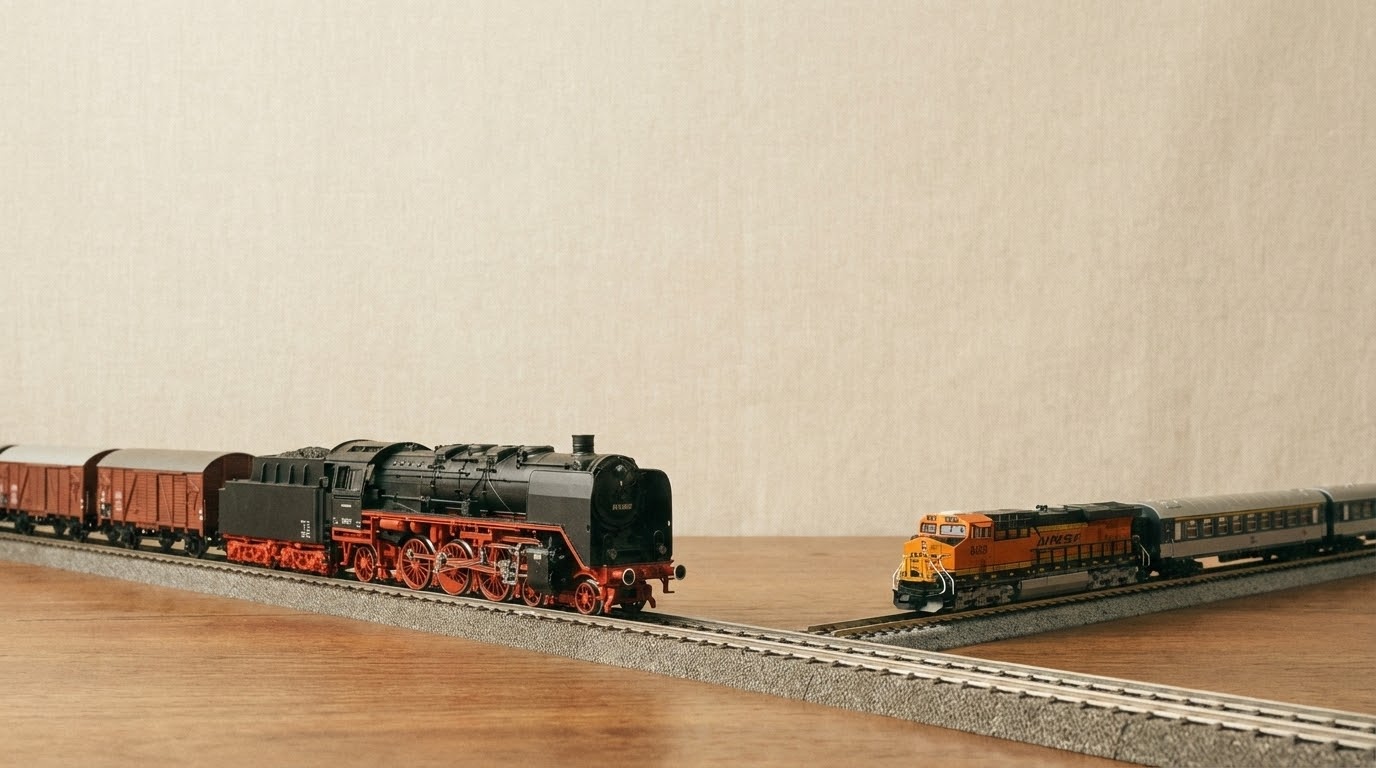
HO Scale vs N Scale
Choosing between HO scale and N scale ranks among the most consequential decisions a model railroader makes. Your choice affects available space, budget, detail level, and even the types of scenes you can realistically model. Both scales have passionate advocates, and both offer genuine advantages. This guide breaks down the differences so you can choose with confidence.
Understanding Scale Ratios
Scale expresses the relationship between model and prototype. It’s a ratio showing how many units in the real world equal one unit on your model.
HO Scale: 1:87
HO scale means one foot on your model equals 87 feet on the real railroad. The name derives from “Half O,” as HO is approximately half the size of O scale (1:48). A typical HO scale locomotive measures 6-8 inches long. Track gauge—the distance between rails—is 16.5mm.
N Scale: 1:160
N scale uses a 1:160 ratio, making it roughly half the size of HO. The “N” originally stood for “nine millimeters,” referring to the track gauge. An N scale locomotive typically measures 3-4 inches long. This smaller size allows dramatically longer trains and larger scenery in the same physical space.
The Practical Difference
Think of it this way: if you have a 4×8 foot table, an HO layout might accommodate a small yard and simple loop. The same table in N scale could hold a believable mainline with passing sidings, a small town, and sweeping curves that look prototypically graceful.
Space Requirements: The Decisive Factor
For many modelers, available space determines scale choice. N scale’s smaller size offers genuine advantages for space-constrained hobbyists.
HO Scale Space Needs
A basic HO oval requires roughly 4×6 feet minimum. Standard 18-inch radius curves work but look tight. More realistic 22-inch or larger radius curves demand more room. A satisfying HO layout with industries, passing sidings, and credible scenery typically needs 5×9 feet or larger. Shelf layouts along walls can work in narrower spaces—12-18 inches depth minimum.
N Scale Space Efficiency
N scale shines in tight quarters. An impressive layout fits on a hollow-core door (approximately 30×80 inches). Standard 9.75-inch radius curves allow continuous running in minimal space, though 11-inch or larger radii look more realistic. An N scale empire comparable to a large HO layout fits in a single bedroom.
The Space Multiplier
Here’s the key math: N scale offers approximately four times the layout area in the same physical space. A 4×8 N scale layout equals roughly 16×32 feet in HO terms. This means longer train runs, larger yards, and more expansive scenery.
Detail and Visibility
Larger models show finer detail. This simple fact gives HO a significant advantage for modelers who prize visual precision.
HO Scale Detail
Modern HO equipment showcases remarkable detail. Separate grab irons, see-through fans, wire handrails, and etched metal parts create museum-quality miniatures. You can see and appreciate these details from normal viewing distances. Weathering shows clearly. Small figures have recognizable faces.
N Scale Detail
N scale detail has improved dramatically over the past two decades. Top-tier N scale locomotives now rival HO from five years ago. However, physical limitations apply. Some details simply can’t be modeled at 1:160. Grab irons are often molded rather than separate. Weathering requires more skill to remain visible. Figures appear as impressions rather than individuals.
Viewing Distance Matters
Consider how you’ll view your layout. If you stand back and watch trains move through scenery, N scale’s reduced detail becomes less noticeable. If you prefer examining locomotives up close, HO’s larger size rewards scrutiny.
Product Availability and Selection
HO scale dominates the North American market, and that dominance affects what you can buy.
HO Scale Selection
Virtually every North American prototype has been produced in HO. Want a specific locomotive from a specific railroad in a specific era? Chances are someone makes it in HO. Freight cars, passenger cars, structures, vehicles, figures—the selection is unmatched. Multiple manufacturers compete in popular categories, keeping quality high and prices competitive.
N Scale Selection
N scale selection has expanded significantly but remains narrower than HO. Major locomotive types are well covered. Common freight cars are readily available. However, obscure prototypes, specific road numbers, and niche items are harder to find. The passenger car selection lags behind HO, particularly for prototype-specific cars.
The Manufacturer Landscape
HO scale manufacturers include Atlas, Athearn, Bachmann, Broadway Limited, ExactRail, InterMountain, Kadee, Kato, Proto 2000, ScaleTrains, and Walthers—among many others. N scale has fewer players: Atlas, Athearn, Bachmann, Kato, InterMountain, MicroTrains, and ScaleTrains cover most of the market.
Cost Comparison
Model railroading requires investment regardless of scale, but costs differ in specific categories.
Locomotive Costs
Quality locomotives cost similarly across scales. A top-tier DCC-sound equipped diesel runs $250-400 in either scale. Basic DC locomotives start around $50-80. The misconception that N scale is cheaper per unit generally doesn’t hold for locomotives.
Rolling Stock Costs
Freight cars show similar pricing. Premium cars cost $30-50 in either scale. Economy cars run $10-20. N scale cars contain less material but require proportionally more precision in manufacturing.
Track and Structure Costs
N scale gains an advantage in track—you need less linear footage to create the same visual effect. Turnouts cost somewhat less in N scale. Structures also cost less because they’re smaller and require less material.
Total Layout Cost
An equivalent N scale layout—one that models the same railroad scene with the same operational capabilities—costs roughly 70-80% of an HO layout. The savings come from reduced track, smaller structures, and less scenery material. However, if you fill your N scale space with more railroad than you’d have built in HO, costs even out.
Handling and Maintenance
Working with small parts requires different skills and tools across scales.
HO Scale Handling
HO equipment handles comfortably. Locomotives have heft and presence. Couplers are easy to see and manipulate. Track laying and wiring proceed at a manageable pace. Most adults can work with HO equipment without strain. Reading road numbers and identifying cars is straightforward.
N Scale Handling
N scale demands steadier hands and better eyesight. Couplers require patience to operate and replace. Derailing cars during rerailing attempts is common until you develop technique. Many N scalers use magnifying visors or lamps. Tweezers become essential tools. Those with vision challenges or hand tremors may find N scale frustrating.
Maintenance Considerations
Both scales require track cleaning, though N scale’s smaller rail collects proportionally more contamination relative to surface area. Locomotive maintenance is simpler in HO—mechanisms are more accessible. N scale motor and gear work often requires specialized tools and considerable patience.
Operating Characteristics
How trains perform matters as much as how they look.
Train Length and Realism
Real North American freight trains stretch 100+ cars. In HO, a 20-car train looks reasonably long and fills a modest yard. In N scale, you can run 50+ car trains that actually approach prototype proportions. This length difference significantly affects operational realism.
Curves and Grades
Both scales handle curves and grades, but N scale’s shorter cars negotiate tighter radii more gracefully. Long HO passenger cars look awkward on 18-inch curves. N scale equipment handles 11-inch curves without obvious overhang.
DCC and Sound
DCC works identically in both scales—the technology is scale-independent. Sound systems, however, differ. HO locomotives have room for larger speakers producing better bass response. N scale sound has improved dramatically but still can’t match HO’s audio quality, particularly in steam locomotive sound.
For more on choosing between control systems, see our DCC vs DC comparison guide.
Who Should Choose HO Scale
HO scale suits modelers who:
- Value fine detail – You want to see every rivet and appreciate hand-applied details.
- Have adequate space – You can dedicate a spare room, basement section, or at least 5×9 feet.
- Model specific prototypes – You need access to the widest possible product selection.
- Prefer hands-on work – You enjoy maintenance and detailing without magnification.
- Prioritize sound quality – You want the best possible DCC sound performance.
- Are returning to the hobby – Your childhood trains were probably HO, and familiarity helps.
Who Should Choose N Scale
N scale suits modelers who:
- Face space constraints – You live in an apartment, share limited hobby space, or prefer a portable layout.
- Want longer trains – Realistic train length matters more than individual car detail.
- Model expansive scenes – Mountains, prairies, and sweeping curves appeal to you.
- Enjoy the scenery focus – Trains as part of a landscape rather than the landscape serving trains.
- Have patience and precision – Steady hands and good eyes make N scale enjoyable rather than frustrating.
- Value portability – You want to transport layouts to shows or club meetings.
Other Scales Worth Considering
HO and N dominate but aren’t your only options.
O Scale (1:48)
O scale offers maximum detail and presence but demands substantial space. Popular for those with large basements or who focus on short switching layouts.
Z Scale (1:220)
Even smaller than N scale, Z allows briefcase-sized layouts. Product selection is limited, and handling is extremely challenging.
S Scale (1:64)
S scale splits the difference between HO and O. American Flyer nostalgia drives some interest, but product availability is limited.
On30 and HOe/HOn3
These narrow gauge variations use HO track for larger scale equipment, modeling narrow gauge prototypes. They offer unique modeling possibilities.
Making Your Decision
The “right” scale is the one that fits your space, budget, vision, and physical capabilities. Neither HO nor N scale is objectively superior—they optimize for different priorities.
Visit a hobby shop and handle equipment in both scales. Attend a train show where layouts in multiple scales operate. Join an online forum and look at layouts you admire—what scale are they?
Many modelers try both scales over their hobby careers. Some maintain parallel projects. A few convert entirely from one to the other. The important thing is starting somewhere and learning by doing.
For those ready to begin their journey, our Getting Started with Model Railroading guide provides the next steps. And when you’re ready to plan your space, our Layout Design Tips article covers planning strategies for any scale.
Frequently Asked Questions
Is N scale harder to work with than HO? +
Yes, N scale requires more precision. Smaller parts mean smaller tolerances. Couplers require more careful handling. Many modelers use magnification for detailed work. However, the difficulty is often overstated—millions of hobbyists work successfully in N scale. If you have reasonably steady hands and good eyesight (with glasses if needed), N scale is manageable. The learning curve is somewhat steeper, but technique improves with practice.Which scale has better DCC sound? +
HO scale has better sound quality due to larger speaker enclosures. The physics of sound reproduction favor larger speakers—they produce better bass response and overall volume. N scale sound has improved dramatically with advances in speaker technology, and modern N scale sound locomotives are impressive. However, side-by-side, HO sound systems produce richer, fuller audio. For steam locomotive sounds especially, HO maintains a noticeable advantage.Can I run both scales on the same layout? +
Not practically. The track gauges differ significantly (16.5mm for HO vs 9mm for N), and equipment proportions would look wrong together. Some modelers maintain separate layouts in different scales. A few create “dual-gauge” track with three rails—possible but complex. If you’re uncertain about scale choice, it’s better to start with one scale and commit rather than attempting to combine them.Is N scale really cheaper overall? +
It depends on how you measure. Quality locomotives and cars cost similarly per piece across scales. However, N scale requires less track, smaller structures, and less scenery material to create comparable scenes. A layout modeling the same prototype operation typically costs 20-30% less in N scale. But many N scalers use their space efficiency to build larger railroads, negating cost savings. Budget carefully in either scale.What if I choose wrong? +
Scale changes happen in the hobby, though they’re costly and time-consuming. Used equipment markets in both HO and N are healthy—you can sell what you have and start fresh. Some modelers maintain both scales for different purposes. The “wrong” choice isn’t catastrophic; it’s a learning experience. That said, thoughtful initial selection based on your space, vision, and capabilities minimizes the chance of wanting to switch later.
The Scale That’s Right for You
Both HO and N scale have built magnificent layouts and supported countless hours of enjoyment. The best scale is the one that lets you build the railroad you envision in the space you have with the skills you possess—or are willing to develop.
Don’t let analysis paralysis prevent you from starting. Choose the scale that feels right, buy your first train, lay your first track, and begin learning. The hobby rewards those who start building rather than endlessly deliberating. Your first layout won’t be your last, and experience teaches lessons no guide can provide.
Affiliate Disclosure: Off The Rails participates in affiliate programs. Links to products may earn us a commission at no extra cost to you. We only recommend products we genuinely believe benefit the hobby.